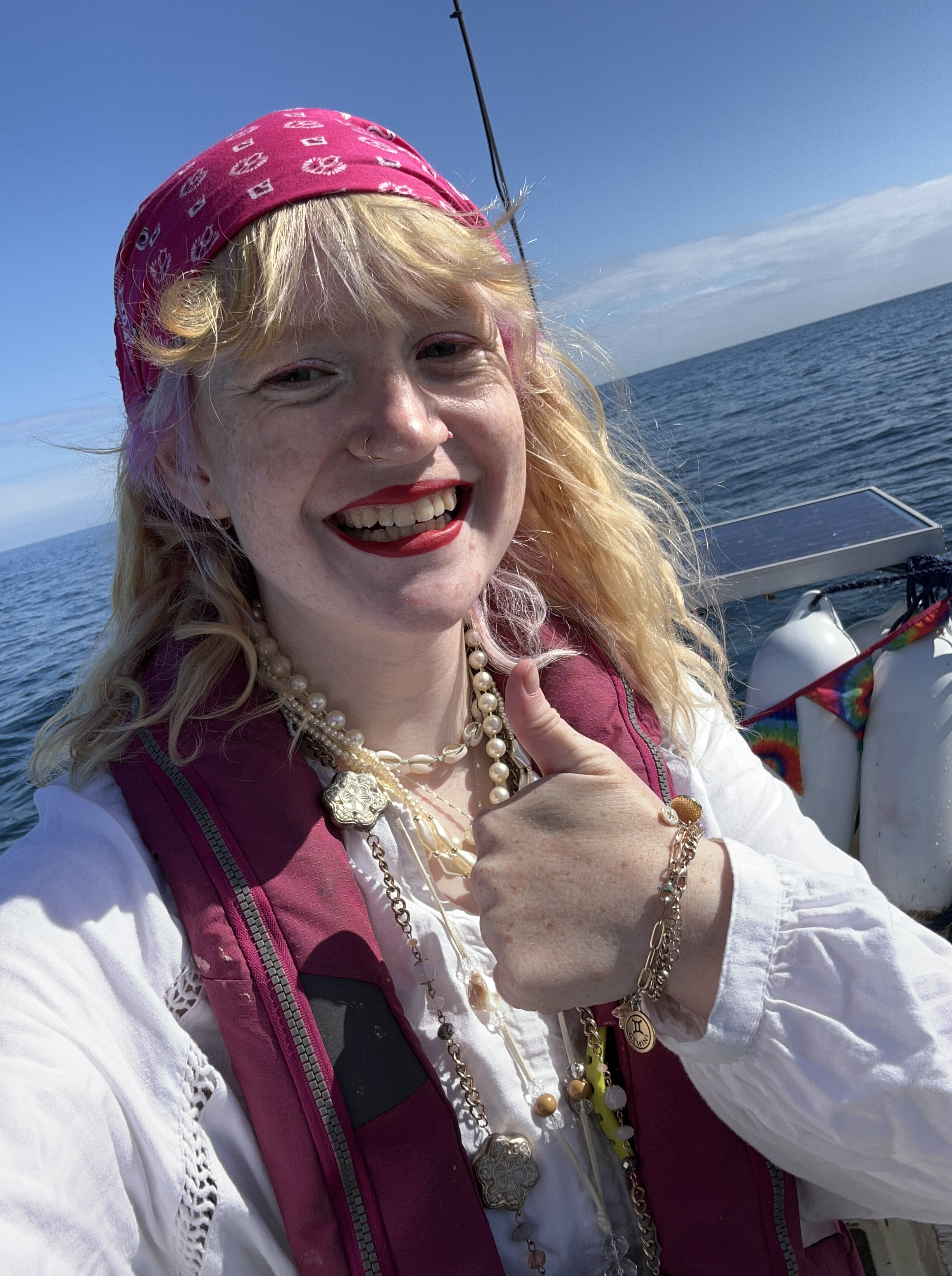
It’s been a while since I last posted here — and for those who’ve been following my journey, thank you for sticking around through the quiet. I haven’t disappeared. I’ve just been weathering a different kind of storm.
After months at sea, I came home to the stillness of winter. The cold settled in my bones, and the quiet crept into my head. Coming back after the adrenaline and challenge of the sail — after the constant motion — left me with a heaviness I couldn’t quite name.
The low after the high is real.
The sea gives you purpose every single day. Land doesn’t always do that.
There’s something I want to share — something I haven’t written about before. It’s difficult to talk about. It’s scary. But it feels important. Necessary. And I hope it helps explain my silences online.
Let’s talk about feminism — a word that makes some people uncomfortable. It’s easy to look at how far women have come, and yes, that progress is real. But the barriers we still face aren’t always obvious. They’re quiet. Subtle. Insidious. They sneak in through trust, through assumptions, through everyday expectations.
I want to talk about some of the experiences I’ve had along my trip — some big, some small — but all part of the same pattern.
I’m a woman. And I’m pretty feminine — not in a way I try to be, but just in who I am. It’s part of how I move through the world, including how I sail. I dress the way I want. I keep my head up. I stand tall. But in this environment, that often makes me stand out. And sometimes, I get judged for it.
Sometimes the judgment is direct.
“No you won’t — you’ll have a boyfriend by then and he’ll do it.”
I remember when I first bought this boat. I was in the yard, chatting to someone about my plans — about the big solo journey I was preparing for. He laughed. Actually laughed. And said, “No you won’t — you’ll have a boyfriend by then and he’ll do it.”
As if that was the inevitable outcome. As if I couldn’t possibly be the one at the helm.
Sometimes the judgement is quieter — hidden behind assumptions.
“Can you go fetch the skipper?”
I arrived into port after sailing 80 nautical miles solo. The harbour master came to greet me and immediately asked, “Can you go fetch the skipper?” I don’t know who he thought was skippering a hot pink boat… but apparently not the girl with pink hair standing right in front of him.
And sometimes, it’s more than judgement. Sometimes, it’s not just about being the only girl in a room full of men. It’s about personal safety.
In the boating world, we talk a lot about safety — emergency beacons, flares, radios, MOB drills. But we rarely talk about the other kind of safety. The kind women have to think about every day.
Can I trust this person? Am I safe on this boat? What happens if something goes wrong — not with the weather, but with someone’s behaviour?
On land, we talk about not walking alone at night. We share our locations with friends. We have code words, exit plans. But at sea — those conversations are far rarer.
And they matter just as much.
This is a big issue. I know I can’t solve it alone. But I can tell my story. And I hope, as you read it, you’ll pause to consider the experiences of those around you — even if they’re different from your own.
I’m not naming names, and that’s okay. This isn’t about one man. It’s about a pattern — one that many people know all too well. It’s about grooming. About trust being slowly built, then slowly pushed. It’s about learning to recognise the warning signs before things escalate.
This wasn’t my only bad experience. And it wasn’t the worst. But that’s part of the point — this kind of behaviour happens every day, in every setting. It doesn’t have to be dramatic or violent to be serious.
If someone is overstepping your boundaries, making you feel unsafe, fearful, or unsure of yourself — that is not okay. You don’t need it to be “bad enough” to name it. You don’t need permission to leave.
Someone I met during my trip — older, respected, well-connected in the sailing world — he invited me onto his boat. We’d been in contact for months, online and in person. He offered me connections, introductions, sponsorship opportunities, and promises of so much more. I thought he wanted to support my journey. I thought I was safe.
But once I got there, it became clear I wasn’t.
The way he spoke. The lies. The things he did. The way he ignored boundaries I thought I’d clearly set. It wasn’t always overt, but it was constant — pressure disguised as mentorship, entitlement disguised as interest. He’d say one thing, then the opposite. He lied, twisted the truth, gaslit me — made me feel stupid or to blame when I tried to make sense of it. I was left second-guessing myself, unsure of what was real.
I felt unsafe. I was scared — not just of what was happening, but of where it could lead.
It took everything in me, but I trusted my gut and left. Saying no isn’t always safe. Walking away can provoke confusion, anger, or worse. I didn’t feel safe enough to explain, to confront, to say it outright — so I didn’t. I packed my bags quietly and left in the early hours of the morning.
And I was lucky. Lucky that I was somewhere I could leave. Lucky we weren’t at sea. Lucky we weren’t on a small island, cut off from escape.
But here’s the thing: It shouldn’t come down to luck.
It shouldn’t be “lucky” to get out of a situation that threatened me. It shouldn’t be seen as fortunate just to be treated like a human being with boundaries. I shouldn’t have had to go through that in the first place.
Even after I cut contact, the behaviour didn’t stop — there were private messages, messages to my friends, even other people sent to my location without warning. That quiet, unspoken trust we often share as sailors, crewmates, adventurers — it was shattered.
The water should be a safe space for all to enjoy.
For me, sailing has always meant freedom, joy, and possibility. But this was fear. Gut instinct. And the kind of heartbreak that only comes from being treated like a prize instead of a person.
It didn’t break my confidence in myself — but it shook my trust in others. I became sharply aware of how young I still am. That I’m travelling alone. That I’m visible.
I started to feel afraid to exist as myself online. I began questioning how much I was sharing — and who was watching.
But I have a choice here.
Thanks to DBT therapy, I’m learning how to face these fears with tools that help — things like checking the facts and using opposite action. I’m choosing not to let shame or fear keep me silent.
I’ve also been rebuilding. I took a short course at my local college to help prepare me for university. I missed out on a lot of education because of my health — but this trip, this wild and brave idea, opened my world back up. It reminded me that life can still be big, even if your world has been made small by trauma or illness.
My body followed where my mind had gone — into overwhelm. My periods became unbearable — heavy, painful, and completely debilitating. I found myself crawling to the bathroom, dizzy, bleeding through everything, unable to stand upright. Codeine barely touched the pain. I was prescribed the combined pill, and while it took the edge off physically, it completely unravelled my mental health.
Within weeks, I was in crisis.
I’ve lived with mental health difficulties for years. I’ve learned to ride the waves. But this was a relapse — one I didn’t see coming. Everything felt too loud, too heavy, too much. I got help. I reached out. And I’m still here.
That’s the thing about recovery: it isn’t linear. You can be doing everything right, feeling stronger, moving forward — and still hit a wall.
I sometimes think that makes me weak. But to quote my favourite show Grey’s Anatomy:
“The key, though, win or lose, is not to fail. And the only way to fail is not to fight. So you fight until you can’t fight anymore.”
Still, it’s hard to talk about these things online. There’s so much pressure to present a perfect, inspirational recovery story. But I don’t owe anyone that.
The sea taught me how to keep moving, even when everything feels uncertain. So I’ll take what I have, ask for help when I need it, and keep going.
The route might shift. The timing might change. I might have to do things differently.
I know this: I will sail again. Because that part of me — the part that dares, that dreams, that moves forward — never left. She’s still here. And she’s not done yet.
I’ll return to the sea — not because I have something to prove, but because that’s where I feel most free. Most me.
Have you ever felt something like this?
Maybe not at sea, but in sport, in travel, in life — that moment when your safety, your freedom, or your confidence was quietly taken from you. Not always in a way that looks dramatic, but in a way that stays with you. That shifts how you see yourself, or how you move through the world.
If any of this resonates — I’d really love to hear from you.
Right now, I’m asking for support. Not just financial (though if you know someone who might sponsor part of the trip, please reach out — like many adventurers, I’ve run out of money…). I’m also asking for encouragement. For solidarity. For kindness.
Send me your stories. Your advice. Your favourite books or films. Something practical, or just a message that says, “You’ve got this,” or “I see you.” It all makes a difference. It keeps me going.
This time, as I complete the voyage, I’ll also be raising money for Mind — a mental health charity that’s helped people like me when things got dark. I want to give something back.
Thank you — truly — for reading. For being here. I’m still dreaming. Still fighting. Still sailing.
P.S.
I’ll be sharing another update soon with more practical details — the kit I’ll need, what still needs funding, and the plan to get back out there. I’ll also talk about the boat: what’s working, what needs fixing, and what I’ll need to do before setting sail.
I’ll share timelines too — the sea trials, the dates I’m aiming for, and how I’m balancing recovery with the need to leave early in the season for the best weather window.
This post has been a check-in — where I’m at, what I’ve come through, and where I’m heading.
Let the dream pull you.
Let the plan guide you.
Let the wind carry you.
More soon — I promise not to go quiet for another six months.


 She sails
Leave a comment